Logan
  • Home
  • Measuring Current History
    • The 2040s are Already Here
    • 1648 Blog
  • Measuring History Series
    • Outer Planet Synodic Cycles Explained
    • Ages of Neptune-Pluto
    • Sixteen Forty-eight
    • People Make History
    • Paradox of Progress
Logan

Written by TD on 08 June 2026. Posted in Measuring History Waves Blogs.

Last Phase, First Phase Sequence of Neptune-Pluto Cycles

Outer Planet Synodic Cycles and the Scales of History

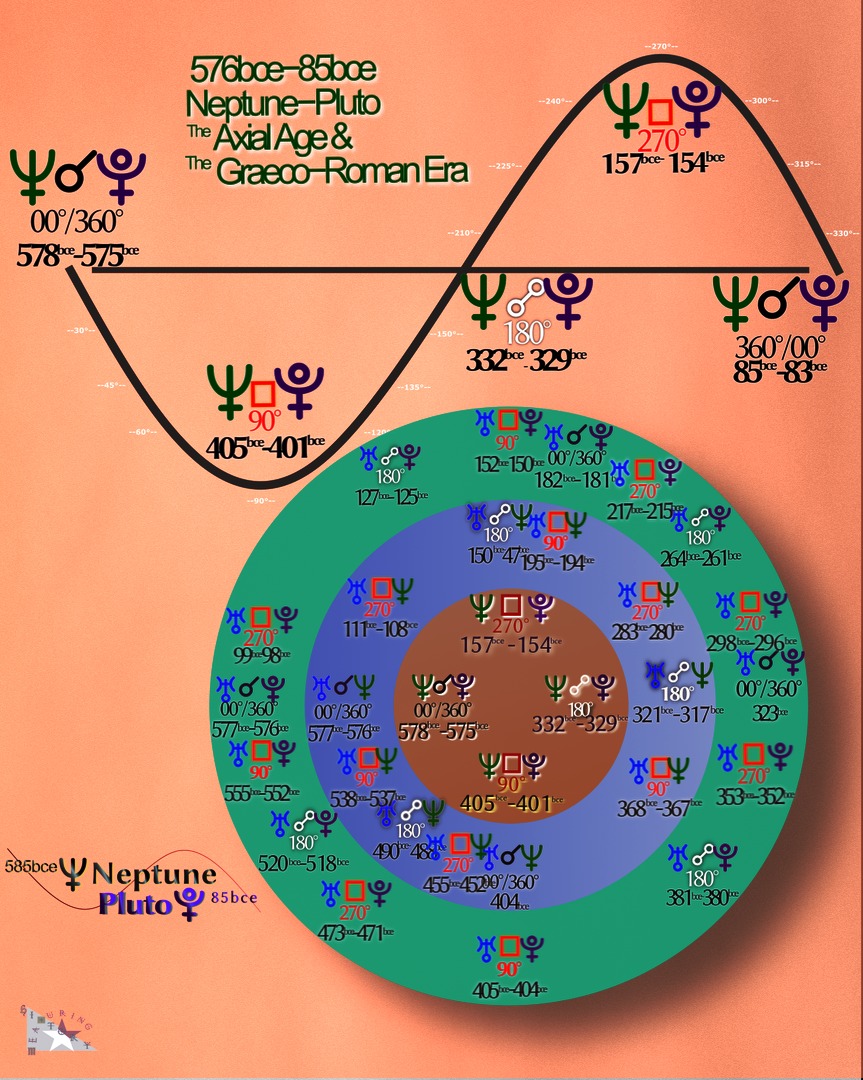
Synodic Outer Planet Synodic cycles and the scales of history work well together. The Neptune-Pluto Trading Cards seen on this page mark the 495-year cycle between the two planets. 500 years seems to provide enough context for history to turn interesting. Mainstream history defines the titles on the cards. Synodic cycle analysis provides holistic context mainstream history lacks. History by millennia, region or topic certainly are valid means to read the past. Outer Planet Synodic Cycles, the heart of Measuring History joins the list.

Last Phase Explains the First

Pluto travels along a skewed path relative to other planets in our solar system. It is narrow on one end, bulges at the opposite end. In the synodic cycle this translate to the following phase sequence (2-3 years):

00/360 to 90  90 to 180 180 to 270 270 to 360/00
172 years 72 years 172 years 72 years

This puts us in 2026 at 35 years away from the end of the first phase of the 1892-2384 Neptune-Pluto cycle 

To put our current place in history in context, the last phase of the previous cycle, 1399-1891 began in the 1810s. This decade puts us in the acceleration phase of the Industrial Revolution. The ideas thereof were in place, but after the 1810s the ideas increasingly turned into factories that darkened the skies of Britian across the 19th Century. During that last phase, humans went from building a few miles of railroad to digging a tunnel through the alps. As the new cycle began in the 1890s, this cycle did not stop. We did  make  a transition into a new Neptune-Pluto cycle, signified as The Digital Age. General Electric incorporated itself in New York state in 1891. The Industrial Revolution, a complete product of the 1399-1891 cycle, laid the foundation for the Digital Age. But that we are in the Digital Age does not mean that we have resolved the issues the Industrial Revolution introduced. We could argue that these issues are even more acute as we move more into the Digital Age. 

Example from the Modern Age Transition

1323 to 1396 1397-1572 1573-1648 1649-1816
72 years 172 years 72 years 172 years
270° to 360/00° 00°/360° to 90° 90° to 180° 270° to 360/00°

The Modern Age arose out of the need to reform the very corrupt Catholic institution at the end of the 14th Century. The eventual Reformation created the conditions that created the Age of Reason, from which the Industrial Revolution emerged. That the Church of the time was overseen by the Borgia clan shows its level of corruption; Martin Luther made his stand against a pope from the very mercantile-minded Demidici family. The issue turned existential because the Church oversaw just about every aspect of daily life.

Last Phase, First Phase Relationship of Church Reform

During the final phase of the 906-1396 Neptune-Pluto cycle, 1323-1395 issues surrounding the Western Church evolved into existential crises. A faction favored by the French crown moved the Vatican to Avignon. Because of Rome's political clout, nobles across Europe became quit worried. Division eventually led to The Great Western Schism, wherein up to three popes claimed the throne. The Church fell further into public question after Black Death in the 1340s. That so many died in the fifty years before the 1390s Neptune-Pluto conjunction in Europe further undermined sentiment. The plague also decimated the ranks in Europe's monasteries, putting pressure on sources of information. The 1399-1891 Neptune-Pluto cycle began with Jan Huss and Jon Wycliffe bringing Church legitimacy into question.

1399-1572: To a Point of No-Return

Martin Luther pinned his 95 Theses in 1517. The Reformation carried on until the Peace of Westphalia in 1648. It reached a point of no-return by the 1570s at Neptune-Pluto opening square. The St. Bartholomew's Day Massacre in 1572 put an end to any hope of compromise. A bit north, the Eighty Years War between the Spanish Netherlands and its inhabitants began about the same time. In 1564, within tolerance of the square, the Church doubled down its campaign against heresy; they used it introduce the Jesuits. Any chance of compromise over religious sovereignty evaporated completely in the decades surrounding the 1572 square. The effects of 14th Century Church corruption, associated here with the 1323-1396 final phase created the conditions that led a to new momentum that played out under the characteristics of the new cycle, one defined as the Transition to the Modern Age.


  • Hits: 7

Written by TD on 04 June 2026. Posted in Measuring History Waves Blogs.

How Graeco-Roman culture still matters

Greece, followed by Rome, used a new model to eventually dominate large areas. In abstract, the model seems innocent: agree to Graeco-Roman culture, provide tribute. You get to keep your culture. Provide us with supplies and we can set up trade that benefits all parties. Simple and abstract, until you add that both cultures benefited greatly from sophisticated slave capture and exploitation. Both sides of that narrative matter. Both Greece and Rome encouraged trade that fit within their system. These blogs will show how that system has evolved, remains in effect and has expanded its reach.

A Surplus Trade System

Anthony courted Cleopatra for her grain. Roman citizens received grain as a birthright. Rome constantly sought grain and other goods. Cleopatra's demise ended the Macedonian influence over Egypt. Its grain then belonged to Rome. To ensure its delivery, Roman law replaced the Macedonian control over the people of Egypt. This model played out across what turned into the "Roman Lake", aka the Mediterranean. That the Christianity that transformed Rome used Greek language after it was subsumed tells us how deeply entrenched the model had become.

"The Roman Empire's intensive demand for wood for fuel, construction, and shipbuilding led to widespread deforestation. This deforestation, combined with overgrazing and intensive farming practices, led to soil erosion and decreased crop yields. One study published in the journal Quaternary Science Reviews found that the empire's agricultural practices may have contributed to significant soil erosion and land degradation.

These practices led to soil erosion rates up to 10 times higher than natural rates, leading to decreased crop yields and the loss of arable land. The resulting food shortages would have contributed to social unrest and weakened the empire's military and economic power."
Key factors in the fall of the Roman Empire: unsustainable farming practices and deforestation

If this example sounds familiar, we are one step closer to the heart of the problem that still faces us. The surplus agriculture model forever demands more land, more resources. The occupants in these places are very often abstract factors, with their fate often quietly deemed from places of great comfort. Rome dangled the benefit of Roman citizenry to further encroach into territory it needed to sustain its consumption levels. Because the surplus trading model, often dependent on a few crops, eventually fails because of its inherent weaknesses, the cycle of land and resource acquirement turns eternal...until it is not.

Different Time, Different Approaches

The way out is simple: the Graeco-Roman Surplus trading model is woefully obsolete. Regenerative, local farming, given current resources and technology, can easily replace a model that, for one thing, encourages wasteful consumption of food and resources. Food grown to solve marketing initatives is food that is not grown to sustain populations. We are on the verge of a global food crisis because the factors that created Graeco-Roman hegemony remain firmly in play: monoculure is by far the most practiced way of producing food worldwide. We still produce food in a crop-by-crop by method in ways that maintain political structures and agenda over ones that provide adequate nutrition worldwide.
Surplus farming makes sense to a point. A significant shift to regenerative farming does not mean that surplus farming will disappear. Subsistence farming today is much more practical than just about any other time in recent history. The practice of growing just enough food for a local community could be part of a larger community with the same goal. In the past, subsistence farming practice in isolation meant passing along knowledge was difficult. Current communication systems remove barrriers.
Industrial farming, which is what surplus farming has become, cannot sustain itself or us in current form. It will continue to cause significant warming of our planet, land degradation and water scarcity. Subsistence may become mandatory rather than an option. Perhaps, the first step is realizing to ask why we are still following the Graeco-Roman model of trade. Those cultures are long past and served a select geographic footprint. Yes, much comes with that statement. The Christian model of politics that is the foundation of the post-modern nation-state grew out of the evolution of the Graeco-Roman culture. That we can no longer follow the path set out by people four millennia past has become front and center.  


  • Hits: 7

Written by TD on 03 June 2026. Posted in Measuring History Waves Blogs.

Introduction to the Lingering Influence of Graeco-Roman Culture and Neptune-Pluto Cycles

Eurasia as it exists today rests on the foundations of Graeco-Roman culture and history. Though the actual components disappeared long ago, how we live today globally points directly back to how both Greece and Rome--giving them the titles here for expediency--permanently built a system of agriculture that still dominates process and thinking across the global farming community. What the system replaced also warrants consideration, because the Graeco-Roman system still sits opposed what we often call regenerative farming. More generically it comes down to an issue of subsistence versus surplus farming. This survey takes place under the lens of the 495-year Neptune-Pluto cycle, taking us back to around 1100bce as the Iron Age began to fade.

576bcenep plu83bce trading cardNeptune-Pluto Cycles and the Ages of History
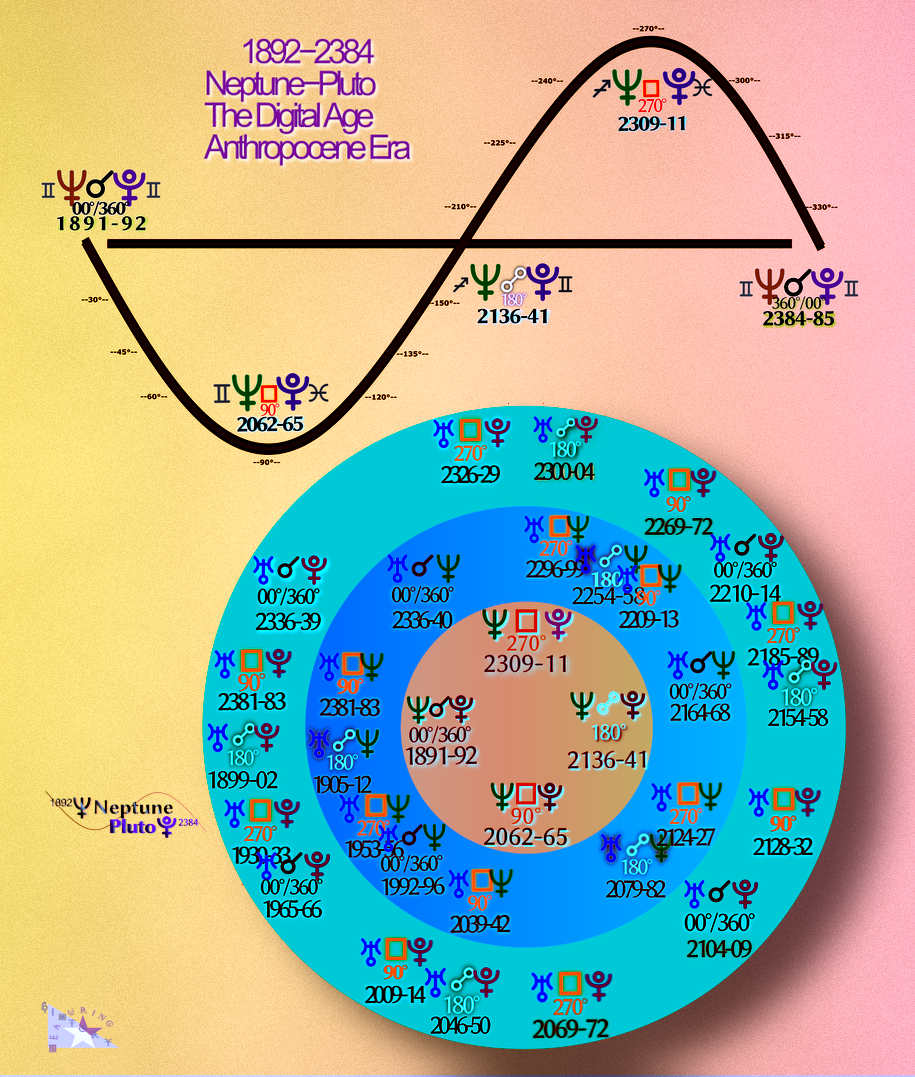
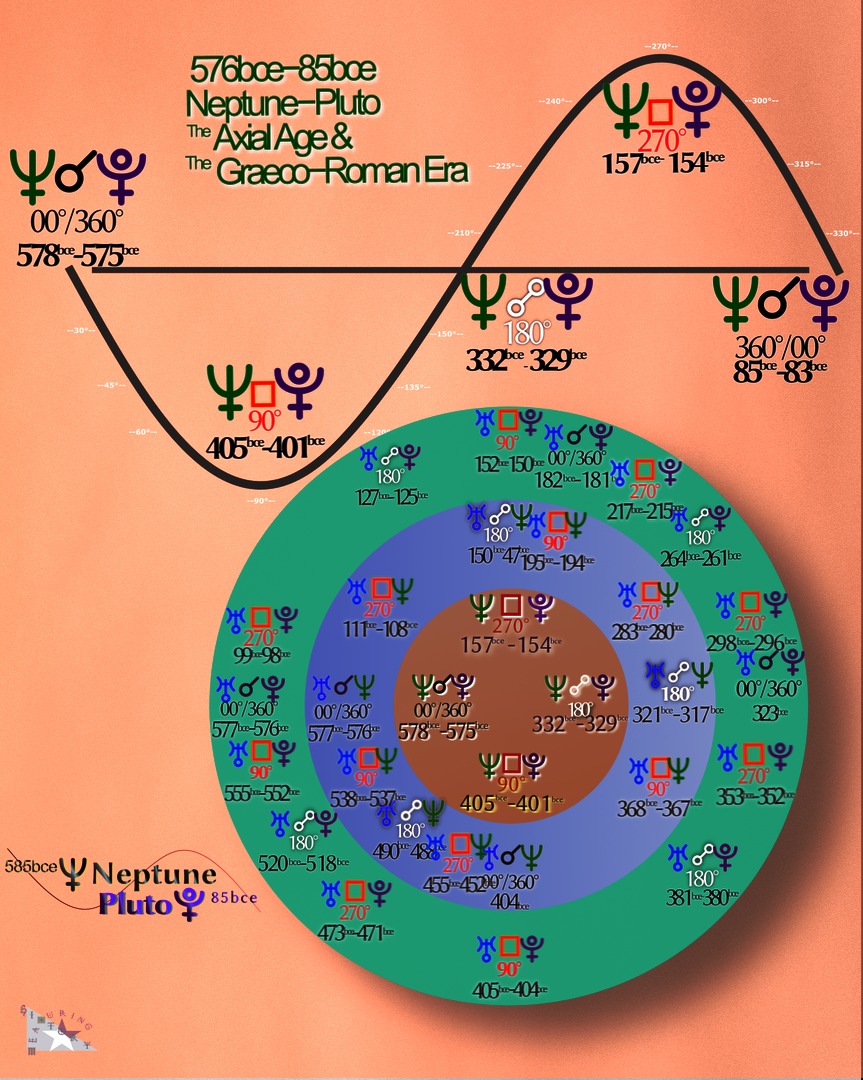
Roman dominance emerged from the Grecian dominance that engendered it. Before Rome existed, Greek hegemony encompassed vast areas of the seas to what is now the Iberian peninsula and many part east of it. Rome supplanted Greece. The Roman worls split into East and West, forming the foundation of tribal makeup of Eurasia. From here the Abrahamic religions helped create the intellectual and poltical structures upon which industrially focused nation-states combined into loosely formed global trading system. These sentences oversimplify of how we got to now (2026) and also describe the episodes we use Neptune-Pluto cycles to describe the transitions between these states. Yeah, this is complicated. It's going to take quite a few episodes to bring it altogether. 3500 years of history deserves some breating space. To add a Neptune-Pluto lens seemingly makes it more so, but the end result will prove opposite: in the end outer planet synodic cycles simplify the narrative.

Read more: Introduction to the Lingering Influence of Graeco-Roman Culture and Neptune-Pluto Cycles

  • Hits: 10
1892Neptune-Pluto2384

Written by Tony Dickey on 12 May 2026. Posted in Measuring History Waves Blogs.

The Ages of Neptune-Pluto Cycles Blog

Neptune-Pluto Cycles are long in human terms: 495 years, give or take 2-3 years. So why blog about a cycle that way exceeds our lifetimes? Perspective.

Cycles within Cycles

the 576bceto83bce Neptune-Pluto cycle 
Every 495-year Neptune-Pluto cycle contains four Uranus-Pluto and three Uranus-Neptune cycles. 
The synodic cycle between Neptune and Pluto is a little different. The span of the first and third phases 
last 172 years; the second and fourth, 72 years.

  • Hits: 40

Written by Tony Dickey on 11 May 2026. Posted in Measuring History Waves Blogs.

Measuring Current History Blogs

Measuring Current History Blogs bring the context of outer planet cycles to realm of periodical reporting.

Everyday seems much more difficult than it used to be. Perhaps the holistic historical perspective of Measuring History can complement our worldview. Might work and probably will change quite a bit over time. In short, research on topics such as The 2040s are Already Here, The Impending Calamity of the Early 20th Century, and The Paradox of Progress at the least gives background to this type of reporting. 

  • Hits: 101

Subcategories

1648 Blog

Logan

Get working experience work with this amazing team & in future want to work together

Contact

455 West Orchard Street Kings Mountain, NC 28086
Phone: +8 (123) 985 789
Email: hello@example.com

© 2026 Logan Joomla 6 Template by Joomlead
  • Home
  • Measuring Current History
    • The 2040s are Already Here
    • 1648 Blog
  • Measuring History Series
    • Outer Planet Synodic Cycles Explained
    • Ages of Neptune-Pluto
    • Sixteen Forty-eight
    • People Make History
    • Paradox of Progress