Eurasia as it exists today rests on the foundations of Graeco-Roman culture and history. Though the actual components disappeared long ago, how we live today globally points directly back to how both Greece and Rome--giving them the titles here for expediency--permanently built a system of agriculture that still dominates process and thinking across the global farming community. What the system replaced also warrants consideration, because the Graeco-Roman system still sits opposed what we often call regenerative farming. More generically it comes down to an issue of subsistence versus surplus farming. This survey takes place under the lens of the 495-year Neptune-Pluto cycle, taking us back to around 1100bce as the Iron Age began to fade.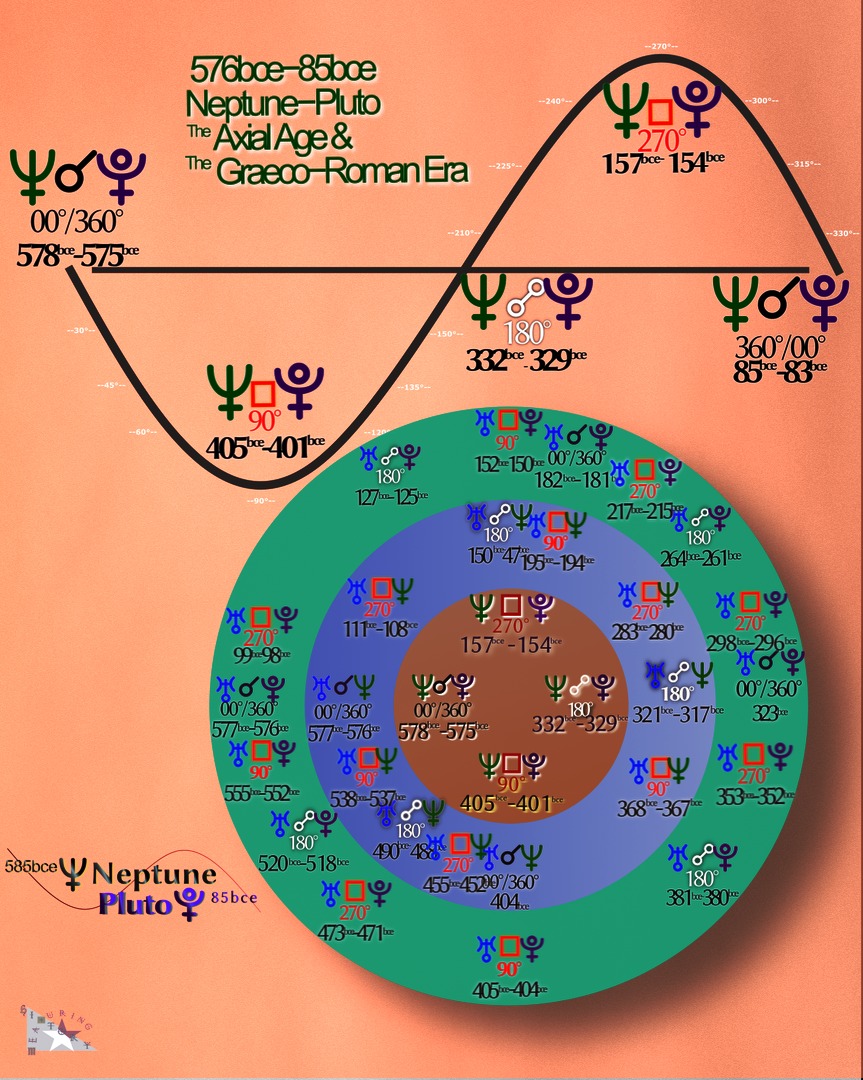 Neptune-Pluto Cycles and the Ages of History
Roman dominance emerged from the Grecian dominance that engendered it. Before Rome existed, Greek hegemony encompassed vast areas of the seas to what is now the Iberian peninsula and many part east of it. Rome supplanted Greece. The Roman worls split into East and West, forming the foundation of tribal makeup of Eurasia. From here the Abrahamic religions helped create the intellectual and poltical structures upon which industrially focused nation-states combined into loosely formed global trading system. These sentences oversimplify of how we got to now (2026) and also describe the episodes we use Neptune-Pluto cycles to describe the transitions between these states. Yeah, this is complicated. It's going to take quite a few episodes to bring it altogether. 3500 years of history deserves some breating space. To add a Neptune-Pluto lens seemingly makes it more so, but the end result will prove opposite: in the end outer planet synodic cycles simplify the narrative.
How to Tell the Neptune-Pluto History of How to Look Past Graeco-Roman Dominance
Yeah, so this is going to take a while. History is like that. Creativity is a bit the same. Think of it as a sometime wandering journey. We have a definitive destination, but we're very open to visiting other related areas. Most simply, the narrative lines with the Neptune-Pluto Trading Cards. These feature the interplay between Neptune-Pluto, Uranus-Neptune and Uranus-Pluto cycles. These together with Neptune-Pluto's unique bisymettrical synodic cycle pattern rewards with a singual scale by which to read history and make informed projections into the future. It provides a holistic vision mainstream narratives avoid.
To be clear though, the history outer planet synodic cycles reads is the same that linear, serial versions do. Measuring History adds a built-in outer planet cycle scale that provide the reader with a more holitic way of examing the reality we collectively accepted and recorded voluminously.
Dual Track Narrative
A Neptune-Pluto history of why we live in a world still dominated by legacy of Graeco-Roman dominance is still a history. This exercise reads the history a Neptune-Pluto cycle covers, then diagrams how the three outer planet synodic cycles introduced above provide holistic views that refer to points within and beyond the cycle examined. This attempt at explanation probably more complex than the actual process ends up being.
Graeco-Roman Beginnings
Our narrative begins at the 1075 bce Neptune-Pluto conjunction. This opening chapter covers how Grecian culture rose out of the ongoing collapse of the Iron Age. Some historians label this as a Greek Renaissance period as it rose to dominate an area from Anatolia to the Atlantic. This hegemony helped Rome grow from a small community to a major force by the time of the next Neptune-Pluto conjunction. That's where one of the next chapters begins...